In this post, we discuss our understanding of the two properties of the mind and hypothesize what's meant by the atomicity of the mind in texts like the Nyaya Sutra.
In a commentary on the Nyaya Sutra [1][2], the mind is characterized as an atomic substance:
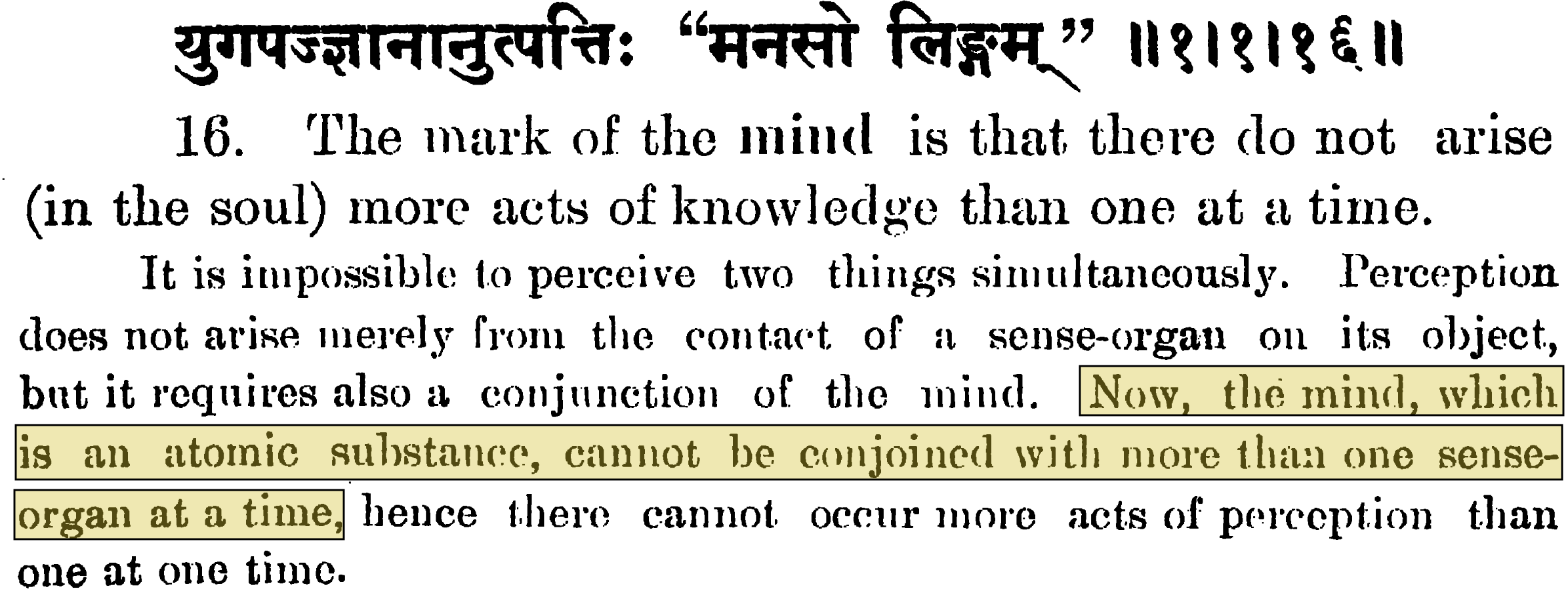
Now, we give an intuitive understanding of what's meant by atomicity. It means that:
- The mind can process inputs from only one sense at a time.
- The mind is always processing input from one sense, even in deep sleep (N3 stage sleep, or slow-wave sleep [3]).
By senses, we mean the five senses, touch, hearing, etc., but we define these senses similarly to how we defined sound [4], i.e., all sensory input that comes to the mind through the concept of ears is sound, making pressure waves just one manifestation of sound.
We support our #1 claim with the common argument that context switching has a cognitive load [5][6], although these studies don't examine switching at the sensory level, i.e., by isolating the senses, and are at the task-level. We argue that if the mind could simultaneously process inputs from two senses, A and B, at a time, then there wouldn't be any load due to context switching. More verbosely, say the mind is processing only sense A and switches to only sense B. If the mind can process inputs simultaneously, then the switch shouldn't involve any cognitive load at all; thus, the switch should be seamless, which is approximately not the case.
We support our #2 claim with research like [7], which note that the mind processes sound even in deep sleep, although the amplification of understandable stimulus is dampened [8]. Assuming that deep sleep is the state of mind in which it does the least sensory processing, even then the mind is processing one sense. So, this supports #2.
We note that books like Brave New World [9] also use a trope based on #2 for brain-washing. Furthermore, we note that we have previously argued that Shruti [10][11] is heard in a meditative state that is like deep sleep through the concept of sound (shabdah), because the mind is processing sound even in the meditative state which is like slow-wave sleep.
Thus, we give our understanding of what's meant by the atomicity of the mind in texts like the Nyaya Sutra, and we provide some simple and straightforward arguments based on easily accessible scientific research.
[2] https://en.wikipedia.org/wiki/Nyāya_Sūtras
[3] https://www.ncbi.nlm.nih.gov/books/NBK526132/
[4] https://m-chaturvedi.github.io/blog/056/
[5] https://pmc.ncbi.nlm.nih.gov/articles/PMC7075496/
[7] https://www.jneurosci.org/content/45/32/e0368252025
[8] https://www.nature.com/articles/s41562-018-0502-5
[9] https://en.wikipedia.org/wiki/Brave_New_World
[10] https://en.wikipedia.org/wiki/Śruti#Distinction_between_śruti_and_smṛti