In this post, we clarify our understanding of what sound is in texts like Nyaya Sutra[1][2]. Previously, we hypothesized that Shruti is heard via ether[3]. We have also written about how the perceived reality can be characterized as a cognitive bias[4]. We use these two ideas to hypothesize our understanding of sound (shabdah).
We first give the traditional scientific understanding of sound and contrast it with what we believe is the understanding in texts like Nyaya Sutra.
The scientific understanding[5] is to characterize sound as a pressure wave, with frequency being the parameter that determines whether the wave can be heard by the human ear or not. The ear converts the pressure wave to an auditory signal that is sent to the brain.
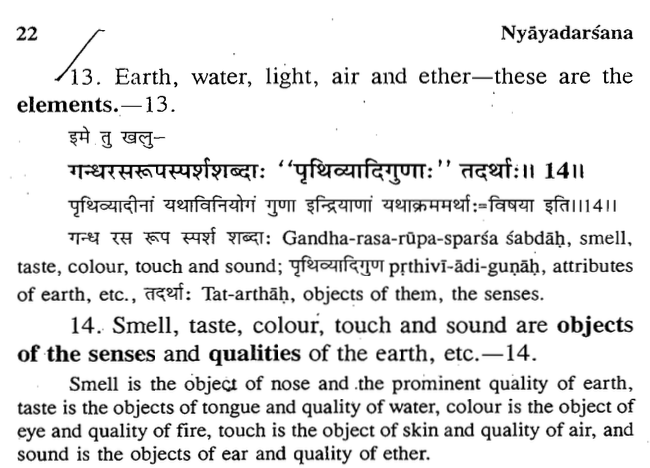
Now, we contrast this with what we believe is sound as characterized by Nyaya Sutra. As we have written about how perceived reality can be characterized as a cognitive bias[4], we believe that when everything is to be understood with only the mind, we would need to define the ear in an abstract manner, that is, as a concept. So, the concept of the ear is that it provides input to the mind. Now, with this understanding, all auditory input that the mind can understand is from the ear, irrespective of whether it can be heard by others or not. So, sound is not a pressure wave with this understanding; it is what the mind can interpret as coming from the concept of the ears. The physical ears that we have become the physical manifestation of the concept of the ears. And sound becomes what the mind can interpret as auditory input, and it may or may not be a pressure wave or be heard by others.
Thus, we have explained what we believe is sound as characterized by texts like Nyaya Sutra.
[1] https://en.wikipedia.org/wiki/Nyāya_Sūtras
[3] https://m-chaturvedi.github.io/blog/055/