In this post, we argue that the two ways of characterizing perceived reality change the definition of enlightenment.
As we mentioned in a previous post, perceived reality can be characterized as a cognitive bias when the mind is disconnected from the body and the senses[1], and perceived reality is to be understood by the mind alone, without the body and senses.
When perceived reality is not considered a cognitive bias, we end up with an interpretation of enlightenment that is caused by detachment from material things. That is, we are born attached, then become detached, and reach enlightenment. Of note here is that both attachment and detachment assume the presence of emotions towards the material world. We have previously noted that this definition leads to Maya being the mother of Buddha[2].
When perceived reality is characterized as a cognitive bias, and we start analyzing enlightenment only from the point of view of the mind, there cannot be any emotions assumed, and we get a definition that is based on knowledge and the lack thereof, i.e., ignorance. So, the definition of enlightenment becomes a change in the state of the mind from ignorance to knowledge. We observe that this change is similar to how the definition of sin changes[3]. So, according to the following definition from Advaita Vedanta[4], the individual is born enlightened but mistakenly identifies themself with the body and senses:
In a popular sense, [A]dvaita is often expressed as the famous diction that Atman is Brahman, meaning that jivatman, the individual experiencing self, is ultimately pure awareness mistakenly identified with body and the senses, and non-different ("na aparah") from Ātman/Brahman, the highest Self or Reality; the knowledge of this true identity is liberating.
We further guess that this difference is due to the fact that the 'means of knowledge'[5] (Pramana) for Bauddha philosophy and Vedanta philosophy, of which Advaita Vedanta is a part, are different:
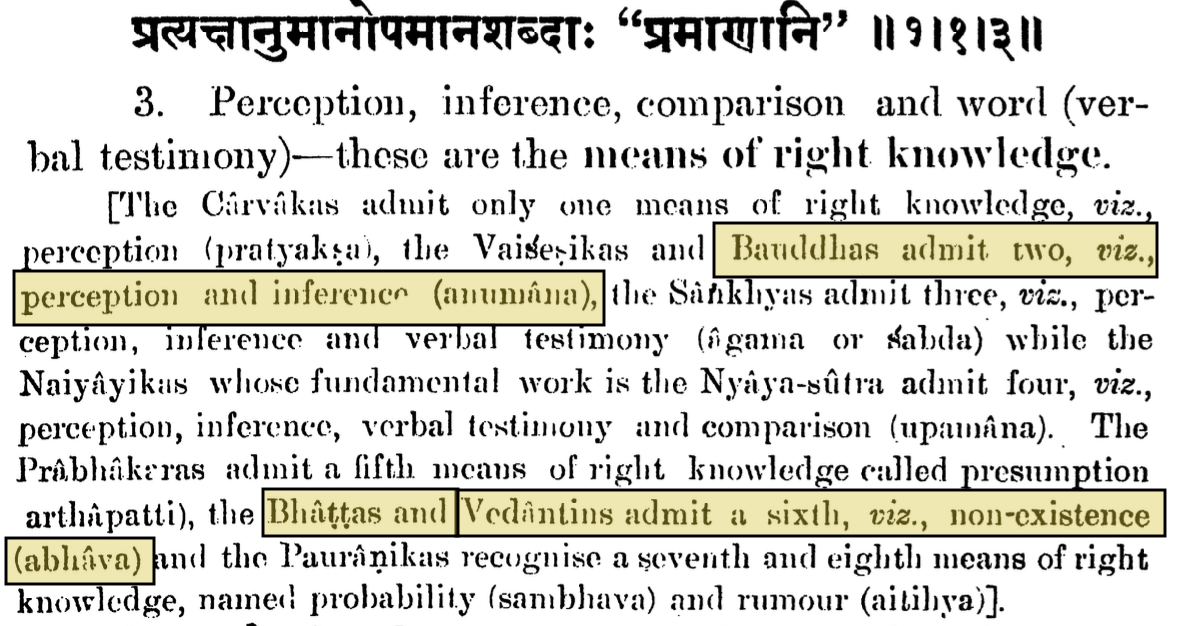
Thus, in this post, we argue that the definition of enlightenment depends on whether perceived reality is characterized as a cognitive bias or not.
[1] https://m-chaturvedi.github.io/blog/038/
[2] https://m-chaturvedi.github.io/blog/040/
[3] https://m-chaturvedi.github.io/blog/061/
[4] https://en.wikipedia.org/wiki/Advaita_Vedanta#Etymology
[5] https://en.wikipedia.org/wiki/Pramana