In this post, we make a note of non-existence[1] (abhava in Sanskrit) being a means of knowledge in the Bhatta[2] and Vedanta schools of thought[3] from a commentary on the Nyaya Sutra[4].
We have extensively written and elaborated on the idea of non-existence being the origin of things because of how our mind works, i.e., our mind creates an abstract representation in order to analyze things[5][6]. This can be stated in another way: the non-existence of something can be a means of knowledge. We were pleasantly surprised to find this as a means of knowledge in Satish Chandra's commentary on the Nyaya Sutra[7]:
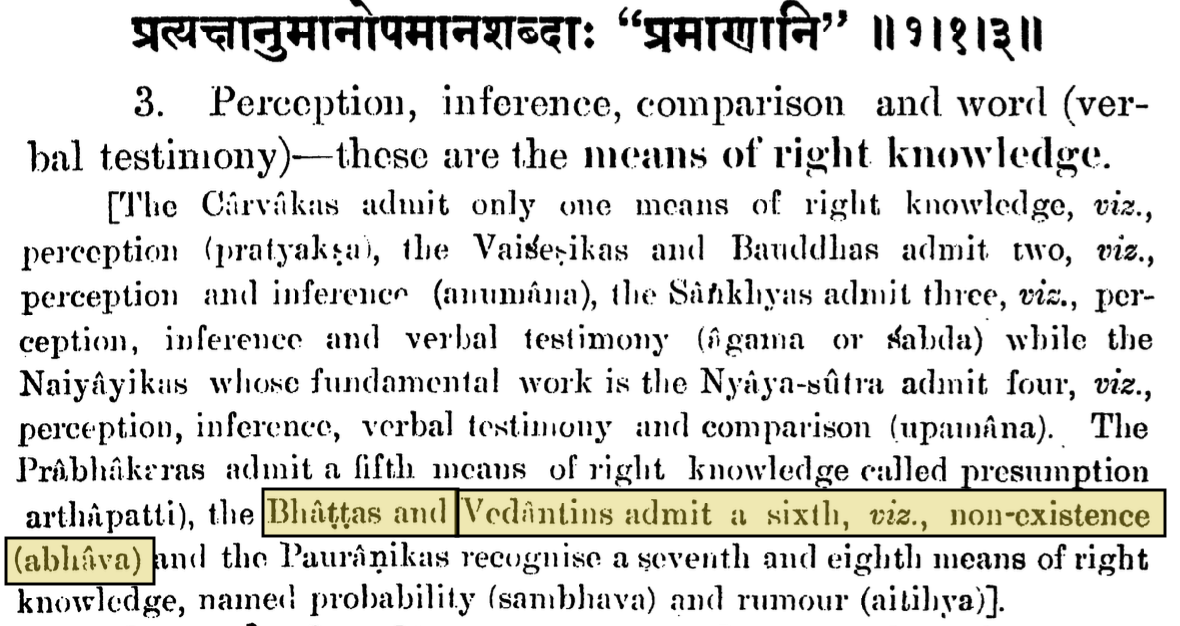
Thus, in this post, we noted an interesting observation about non-existence being a source of knowledge from Satish Chandra's commentary on the Nyaya Sutra.
[1] https://en.wikipedia.org/wiki/Abhava
[2] https://web.archive.org/web/20260821094959/https://www.britannica.com/topic/Indian-philosophy/Purva-Mimamsa-the-Bhatta-and-Prabhakara-schools#ref314717#ref314717
[3] https://en.wikipedia.org/wiki/Vedanta
[4] https://en.wikipedia.org/wiki/Nyāya_Sūtras
[5] https://m-chaturvedi.github.io/blog/017/
[6] https://m-chaturvedi.github.io/blog/040/
[7] https://archive.org/details/TheNyayaSutrasOfGotama/page/2/mode/2up